
So picture this.
I’m a thirty-something-year-old lecturer at a British university. I’ve published some articles and a couple of books. I have a scientific reputation. I’ve traveled to the US and various European countries to do research and give seminars at conferences.
All is great, right?
Except that somewhere along the way I’d developed a passion for computers.
The 1980s were the heady days of personal computing. New machines seemed to appear constantly—the BBC Micro in Britain, Commodore computers, the IBM PC and, most importantly for me, the Apple Macintosh in 1984.
I’d always had a deep connection with biological research, but computers gradually took over my working life. The Macintosh took center stage, and I started writing educational software.
Eventually I left my university job and started a small software company.
It didn’t get much traction in Britain, but one of my early projects, Dictionary of the Living World, attracted attention from Apple Computer in the United States. The American market began opening doors that simply weren’t opening for me at home.
It became increasingly obvious that if I wanted to make a serious attempt at becoming a software author and publisher, America was the place to do it.
So in 1993, I moved to California with my family and started again.
That sounds rather more straightforward written down today than it felt at the time.
Starting again in California
There was something about America -California in particular - that seemed to encourage the idea that starting a company was a perfectly reasonable thing to do.
I’m not sure Britain actively discouraged entrepreneurship, but it certainly didn’t celebrate it in quite the same way. In America, telling somebody you were starting a business generally produced interest rather than raised eyebrows.
For me, that difference in attitude mattered far more than the mechanics of setting up a company.
And America immediately offered other attractions.
It was SO easy to lease a car, and at what seemed to me an extraordinarily reasonable price—although why I chose a purple Honda Civic as my first American car I still can’t fathom.
The grocery stores seemed enormous. And in those early years, American malls were genuinely exciting places to visit. Internet shopping has rather destroyed the wonder of trudging through miles of glittery storefronts, but in 1993 they still seemed impressive.
Then there was California itself.
I’d come from a country of green fields, hedgerows, cows and sheep. Suddenly we had the Pacific Ocean in one direction and mountains and desert in the other.
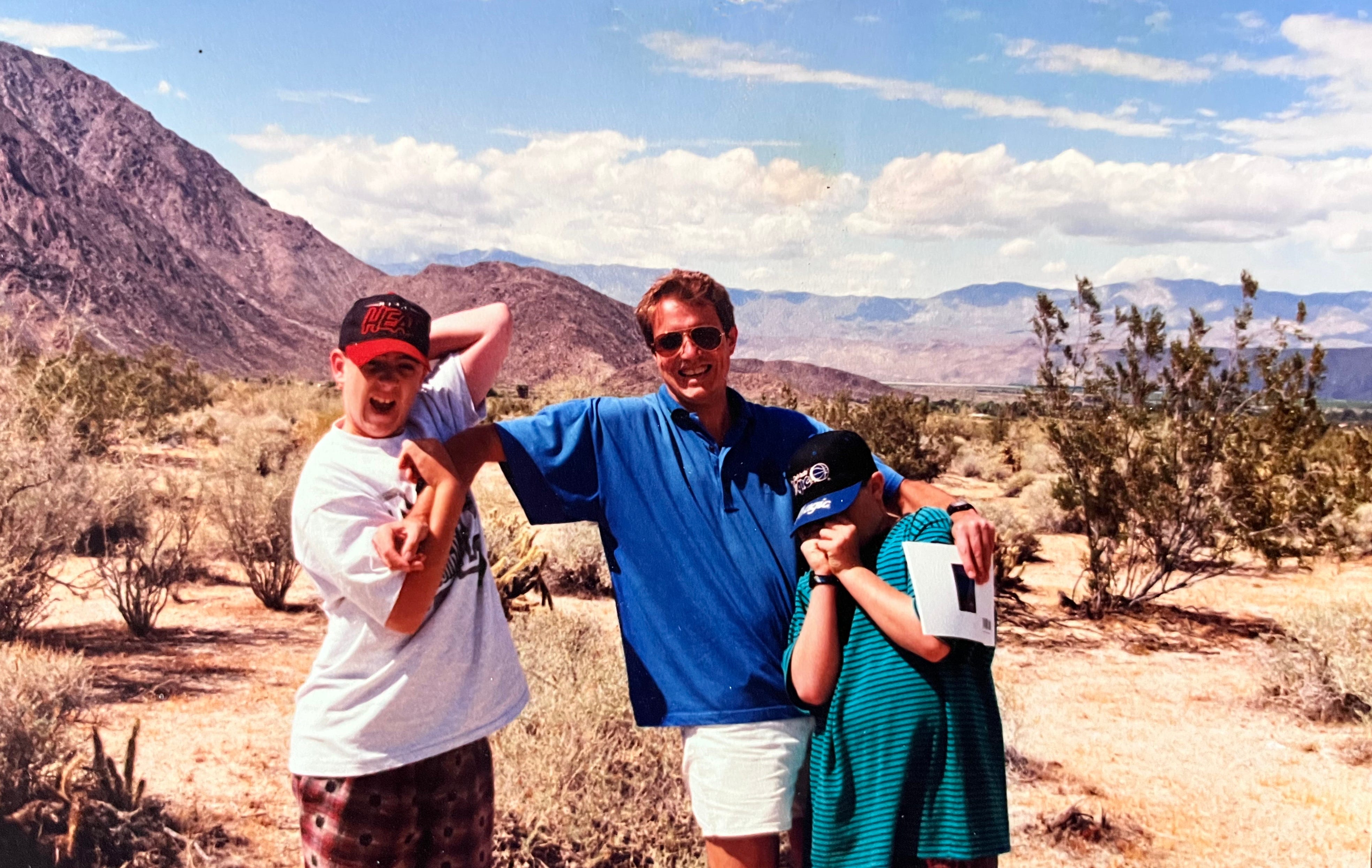
Not long after we arrived, I took my two boys out into the desert near Borrego Springs. I still have a photograph of the three of us standing there.
There’s nothing particularly remarkable about the photograph. It’s just a father and his two sons posing beside a road in 1993.
But when I look at it now, the landscape behind us still strikes me. Dry scrub, mountains, enormous blue sky—about as far removed from the England I’d left behind as I could imagine.
America felt big. Not simply geographically big, but full of possibilities.
And everyday life often seemed wonderfully convenient.
When I first arrived, I was amazed that many stores were open seven days a week. Grocery stores in California might be open from six in the morning until eleven or midnight. That was very different from the Britain I’d left.
I was busy trying to establish a business, so discovering that I could wander into a store whenever I happened to have some free time was wonderfully liberating.
Then came Easter.
My first American Easter
I remember trying to go shopping on my first Easter Sunday and being greeted by deserted car parks and shuttered malls.
Everything had come to a screeching halt.
So even the most capitalistic free-market economy in the world apparently closed down for one day a year.
But there was a much more serious Easter problem.
Chocolate.
I am an admitted chocoholic, and to my horror I discovered that America didn’t seem to have the enormous chocolate Easter eggs I’d grown up with in Britain.
British children learn about this particular form of excess at an early age. Parents give you an Easter egg. Grandparents give you one. Aunts and uncles give you one. Before long a small child can accumulate an unhealthy mountain of chocolate.
I sorely missed this tradition.
Easter was my first introduction to the fact that American holidays weren’t necessarily going to work the way I expected.
Celebrating Britain’s defeat
Then came the Fourth of July.
My first few Independence Days were tinged with a peculiar sense of guilt.
How could I join the festivities celebrating an American victory over the British Army?
This concern didn’t last long.
Once I discovered that Independence Day was largely an excuse for endless barbecues and fireworks, I managed to overcome my patriotic misgivings remarkably quickly.
Halloween was another adjustment. Britain in the early 1990s didn’t celebrate Halloween on anything like the American scale. The costumes, parties and trick-or-treating were all relatively new to me.
I’ve never been particularly enamored with dressing up, so Halloween has never been quite the delight for me that it seems to be for many of my American friends and family.
But there was one American holiday I came to love.
The Thanksgiving phone call
Thanksgiving has always been special to me.
I’d spent about 18 months going through the process of applying for permanent residency in the United States.
Then, on the evening before Thanksgiving in November 1994, my immigration attorney called.
I’d been approved.
I can still remember what an extraordinary moment that was. After the forms, interviews, biometric scans, background checks and waiting, we finally knew that we could stay.
I became a US citizen a few years later, but that Thanksgiving phone call is the moment I associate with America becoming home.
I’ve often thought Thanksgiving is one American tradition Britain really ought to steal.
It arrives at exactly the right time of year, when the days are getting shorter and winter is beginning to feel rather too real. It’s about family, food and taking a moment to appreciate the good things in life.
And I’ve always been a big turkey lover, so having two legitimate excuses for turkey every year—Thanksgiving and Christmas—seems entirely sensible.
I can even almost forgive some of the truly gruesome American Thanksgiving side dishes.
Sweet salads made with Jell-O. Sweet potatoes with marshmallows on top. Mushy green bean casserole.
Almost.
But Christmas was different
If I had to name one thing I still miss about Britain, it would probably be Christmas.
Christmas was the big holiday of my British year. The anticipation seemed to build for weeks as the days grew shorter and December approached.
My first Christmas in California was an utter disappointment.
In Britain, I’d been accustomed to work winding down during the week before Christmas and not really getting going again until the first week of January.
You know the song about the Twelve Days of Christmas?
Well, that was much closer to how Christmas felt.
California in 1993 was rather different.
People might finish work a little early on Christmas Eve. Christmas Day itself was a holiday. And then, remarkably, they went back to work.
Where were the extended visits to friends and family?
The parties?
The sense that normal life had temporarily been suspended?
The joy of the whole season?
Over the years I’ve learned that there isn’t one American Christmas anyway. America absorbs traditions from everywhere.
I remember one year when my son had a Latin American girlfriend and we were invited to her family’s home on Christmas Eve for Christmas tamales.
I loved it.
It was a reminder that leaving one country doesn’t mean simply exchanging one collection of traditions for another. You keep some things, lose some things and acquire completely new ones along the way.
I’ve now spent more than three decades in America.
There are things about American life I prefer enormously. There are things Britain still does better. And there are things about both countries that have changed so much since 1993 that comparisons with the countries I originally knew aren’t always particularly useful.
But I don’t regret making the move.
America gave me the opportunity to reinvent my working life. It gave me a second country to call home. It gave my family experiences we would never otherwise have had.
And it gave me Thanksgiving.
I still think Britain should do something about that.
The marshmallows on the sweet potatoes, though?
America can keep those.